
Sona Khosla
Chief Impact Officer, Benevity
In her role as Chief Impact Officer, Sona is at the helm of Benevity Impact Labs, an incubator and social innovation lab. Sona and her team bring cutting-edge data, research and insights to help organizations and individuals maximize their impact and inclusion efforts, and authentically live their purpose.
Corporate giving rose eight points in 2025 compared to the year prior. In a year where the sector faced harsh political headwinds, peak stakeholder scrutiny and where purpose leaders had to fight for the work, that number is worth celebrating — and it wasn’t achieved alone.
On the Benevity platform, 2025 was, perhaps surprisingly, a record-breaking year:
- $2.7B in total donations
- $2.4B in grants managed
- 23.8M volunteer hours
- 3.2M changemakers taking action
- 312.4K unique nonprofits supported
Those milestones are real, and they matter. And, if we want to keep breaking records, we have to be willing to look deeper.
Those milestones are real, and they matter. And, if we want to keep breaking records, we have to be willing to look deeper.
I’ve spent the last few months immersed in the data behind the 2026 State of Corporate Purpose Report from Benevity Impact Labs, which draws on insights from more than 400 corporate impact professionals and 1,600 nonprofits. Three findings stayed with me, and honestly, they made me a little uncomfortable. If they land the same way for you, it tells us that we can’t look away.
1. Belief in AI is outpacing its adoption.
Almost every company believes AI will help nonprofits: 87% say so. But only 16% have actually made it a core part of their strategy. That gap looks like hesitation. It’s actually something else entirely.
Here’s what the data shows: no matter how far along a company is in its AI journey, most already believe the technology should be used to increase nonprofit capacity. And the further along they get, the stronger that belief becomes. But there’s a disconnect. Even companies at the very earliest stages of adoption — the ones with the least hands-on experience — are already convinced. More than half of companies not using AI at all still believe it should help nonprofits do more.
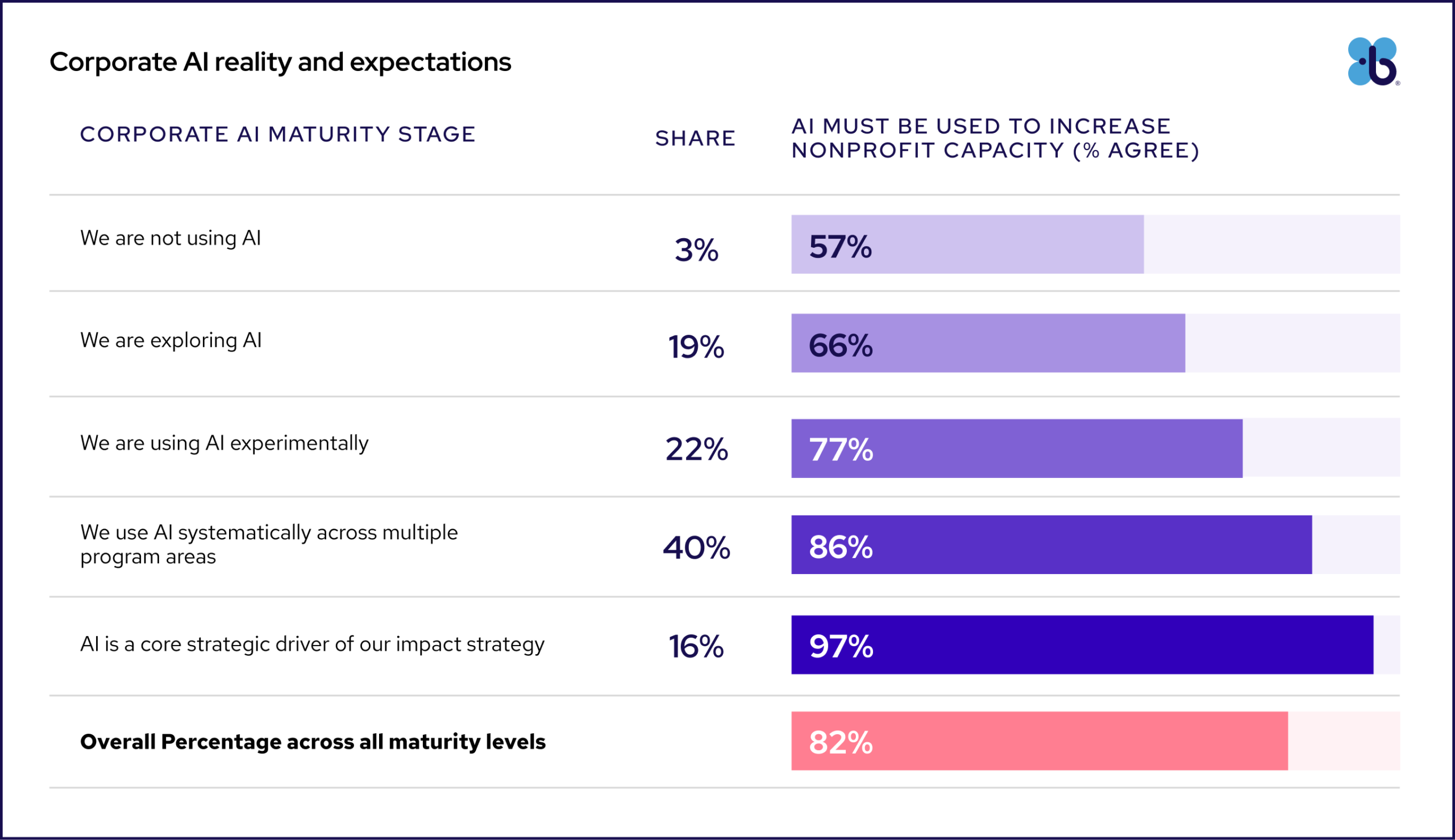
Source: 2026 State of Corporate Purpose report, Benevity Impact Labs, Expectation vs. investment in AI adoption.
The pattern: The more experience a company has with AI, the more it believes in it. One might expect the opposite — that using AI would reveal its limits and cool people off a bit. Instead, belief keeps growing the more people use it. Maybe AI really is delivering. Or maybe we’re still early, and belief is running ahead of proof. Either way, it means more than half of companies with no real adoption are already convinced AI will lighten the load for nonprofits — based on nothing but belief.
So what should companies do? Don’t wait for confidence to build on its own. If you’re just starting out with AI, pair every new pilot with a simple way to measure what it actually changed. Start small, track real results, and let the evidence, not the excitement, decide how fast you scale up and how much you carry your belief to the nonprofit sector.
2. Storytelling spend is up, but so is the cost to nonprofits.
Reputation and trust are the #1 motivator for purpose investment — 91% of companies say so. In response, companies have made communications and storytelling a top priority — jumping from the 9th most-funded area of investment in 2024 to the 2nd most-funded in 2026. This signals more than a budget shift — it signals renewed strategic intent to harness the power of purpose to build a brand.
Here’s the part that gave me pause: more storytelling means more asks for nonprofits. 42% of nonprofits report higher demand for custom metrics, and 44% say custom storytelling requests are climbing. That cost lands hardest on those least equipped to absorb it: 48% of nonprofits are covering the extra work through unpaid staff overtime, and 49% say funders rarely or never fund the associated costs. In other words, companies are asking nonprofits to tell better stories without paying for the storytelling.
If storytelling is going to keep growing as a strategic priority, it can’t keep growing on the backs of unpaid nonprofit staff. Our data shows that almost 50% of companies already build the cost or support of custom metrics and storytelling into their grants. A useful test: if a company is asking for a customized story or dataset, it should be prepared to support the resources it takes to produce it.
3. As federal funding shrinks, corporate funding changes are adding to nonprofit strain.
2025 was a landmark year in federal funding cuts, and many of our nonprofit partners are feeling that strain. What’s less visible is how corporate funding is compounding that pressure. A remarkable 65% of companies changed which nonprofits or programs they funded last year, and 63% required compliance attestation. On their own, these are sensible governance decisions, but together, across a sector already losing public funding, they create additional instability for organizations operating on thin margins.
While these changes are often unavoidable, they don’t have to be hard. Providing ample warning and transition support can make a world of difference for nonprofit partners.
Companies can give nonprofit partners advance notice before shifting funding priorities, phase in new compliance requirements instead of enforcing them all at once (where they are able!), and offer transition support (extra time, guidance, or bridge funding) when a long-standing partnership ends. Introductions to other potential partners are another option some companies exercise. Small adjustments in timing and communication can prevent strategic changes from turning into a crisis for the nonprofits on the receiving end.
What this means for all of us
What the data keeps pointing to is this: belief in this work is strong and the advocacy for continued commitment to purpose within our companies is working. But the individual choices we’re making are quietly reshaping the ecosystem in ways the headline numbers don’t show you, and that is a reason to pay attention.
This sector held its ground this year. That’s real, and it matters. But the next chapter doesn’t get written by holding ground. It gets written by the people who look at the full picture, and decide to do something about it.
Learn how companies are navigating the new world of purpose in the State of Corporate Purpose 2026 report.